Have You Heard That Word Before??

The current image has no alternative text. The file name is: pexels-photo-8419515.jpeg

An author-friend of mine and I often read each other’s work. Last week she used a word in her story that I hadn’t heard before. 

I normally use context clues to gain meaning of unfamiliar words, but in this case I still wasn’t sure. I had to look it up.

I ‘ve heard more than once that readers either skip over unfamiliar words (thus not gaining the express meaning of a sentence) or if the author uses too many of them, they put the book aside.  Sometimes they do look up the meaning. However, they become irritated if there are too many unfamiliar words in a book and most likely will not select books from that author again.

Readers, please share how you react to unfamiliar words in the books that you read. Authors really do want to hear from you. After all, we really do write for YOU!

Lossent

The current image has no alternative text. The file name is: pexels-photo-8419515.jpeg

At a recent book fair, a shopper introduced me to a new word she is trying to get into the dictionary. (I’ll share the word at the end of this post). She is out “campaigning” for this word at book fairs, libraries, grocery stores—anywhere she thinks someone will be interested and will help.

I did some research to aid in my understanding of just how new words do, in fact, join the hundreds of words which are added to the dictionary each year. And, here is what I found:

  1. A words gets into the dictionary when it is used by many people who all agree that it means the same thing. (Used in conversation, books, in movies, editorials, etc.)
  2. Dictionary editors read and look for changes in language in mainstream life. They keep notes on where they “read” the word, its context, and source and key it into a searchable database. 
  3. To be added to the dictionary, they look for three types of usage: frequency, meaningfulness, and widespread use. Once words “qualify,” (such as bucket list, unfriend, selfie) they are added to the dictionary.
  4. Some common words get “new” definitions added, also. Examples would be: cookie and mouse.
  5. Here is the word the book fair lady shared: LOSSENT. It means a person who outlives their biological, fostered, or adopted child and is deeply affected by the loss.
  6. You may want to start using this term and help LOSSENT earn a place in the dictionary!

Throw in a Little Swag

There were 690 words added to the dictionary in September! Why is this important for authors? 

If you are writing contemporary fiction, it is good to use contemporary words. And, if you’re not, then you should refrain from using them. This would be especially true if you write “historical.”

So, I have decided to read through the list of words (you can google them) and their definitions and select ten of them to use in my next book. I intend to use them in much the same way that writers use words in different languages and still get the meaning across to their readers.

A writer-friend read one of my critique group submissions. She suggested that instead of saying that my character received “freebies,” that I use the term “swag.”

Chances are my readers might not have heard that term. So, I will get the meaning across by using context clues. Here’s my example: When people pay two-hundred dollars for an hour long hot-air balloon ride, they expect to get a little swag thrown in. That little enamel pin and glass of champagne only costs us sixty cents, but goes a long way toward good PR.”

So, I have used the new slang word, “swag” in places of “freebies” and then continued the paragraph with another example so readers can deduce the meaning.

I hope you google this list of words because chances are you’ll choose to use some of them in your own reading and writing.

When I Forget the Words

Have you seen instances on television of celebrities, football players, and even olympians who don’t know the correct words to the Star Spangled Banner? Or, perhaps witnessed an interview of a person who got tongue-tied, searching frantically for just that right word?

Writers can write and rewrite on our computers until we get the words to flow just the way we want them. We can use a thesaurus and a dictionary to help us choose words and check on meanings. 

The Describer’s Dictionary by David Grambs is very useful. For example, say you want to describe the color black. The book gives these words: ebony, ebon, sable, jet, onyx, ink black, coal black, anthracite.  The book is divided into words for various Shapes, Patterns and Edges, Surfaces and Textures, Light and Colors, etc.

The Emotion Thesaurus by Angela Ackerman and Becca Puglisi includes all emotions in an easy-to-use alphabetical format that is further broken down into Physical Signals, Internal Sensations, Mental Responses, Cues of Acute or Long Term experiences of an emotion, emotions that specific examples May Escalate To, and Cues of Suppressed emotions. I especially like the Writer’s Tip which is provided at the bottom of each listed emotion.

If you know of any other resources that writers might find useful, please let me know. One I’d find extremely useful would be substitutions for adverbs. If there isn’t one out there, already, maybe this would be a project you’d be interested in taking on!

Are You a Logophile?

32824895204_daeecd7014


In the novel I am currently reading, a teenager tells his grandmother she is phat. She is offended.

Like myself, she didn’t know that phat is slang for cool (also slang).

My grandson uses epic in his speech. Another word that is fairly new in our vocabulary.

Just recently, flatten the curve and social distancing have come onto the scene. Only weeks ago, they had no meaning.

As writers, we need to keep current on new additions to vocabulary and use them in our writing when appropriate. 

The vocabulary we use is a subtle reminder to our readers just what time period we are writing about. It must be consistent with the setting and characters.

It would be ridiculous for an old western cowpoke to exclaim that a cattle drive was epic; or for a young girl living in this current decade to say that a boy she thinks is handsome is the bee’s knees.

Did you know there are an average of one thousand new words added to the dictionary each year?

Are you a logophile (word lover)?

How do you keep up on the current trends in vocabulary? 

Inspirational Words With a Twist

15437460076_a0fe6ae86a

Watch your thoughts,

for they become Words.

Watch your words,

for they become actions.

The are the beginning lines of a well-known inspirational poem.

However, as I look at them, I see a hidden message for us writers.

When I first began writing, I had to break myself of the habit of telling.

I remember having so many critiques returned to me with the following in the comment section:

“Give more thoughts…show more action.”

How?

Word choice.

In a lesson for my young students, I now give an example of how choosing the correct words can make a huge difference in the meaning that is portrayed:

Max walked down the street.

Max ran down the street.

Max skipped down the street.

Max hobbled down the street.

Max fled down the street.

And on and on…

Each new verb changes the picture for our minds’ eye.

And that picture, changes the mood…the intent…the meaning.

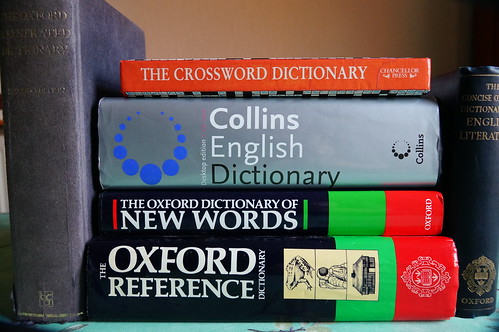
A dictionary, a thesaurus.

These are a writer’s best friends—especially the thesaurus.

They make our work more accurate

more vivid

more exciting.

They change telling stories into “word movies” and ho-hum books into sheer excitement for the reader.

When I Forget the Words

Have you seen instances on television of celebrities, football players, and even olympians who don’t know the correct words to the Star Spangled Banner? Or, perhaps witnessed an interview of a person who got tongue-tied, searching frantically for just that right word?

As writers, we have it a little easier than that. Using our computers, we can write and rewrite until we get the words to flow “just right”. We can use a thesaurus and a dictionary to help us choose words and check on meanings.

I recently bought a book called The Describer’s Dictionary by David Grambs. I must confess I have just begun to use it, but to give you an example of how it works, say you want to describe the color black. The book gives these words: ebony, ebon, sable, jet, onyx, ink black, coal black, anthracite.  The book is divided into words for various Shapes, Patterns and Edges, Surfaces and Textures, Light and Colors, etc.

A book I’ve used a LOT, is The Emotion Thesaurus by Angela Ackerman and Becca Puglisi. I truly believe no fiction writer should be without this book. It includes all emotions in an easy-to-use alphabetical format that is further broken down into Physical Signals, Internal Sensations, Mental Responses, Cues of Acute or Long Term experiences of an emotion, emotions that specific examples May Escalate To, and Cues of Suppressed emotions. I especially like the Writer’s Tip which is provided at the bottom of each listed emotion.

So, there are resources out there. I am slowly finding them. If you know of any others that writers might find useful, please let me know. One I’d find extremely useful would be substitutions for adverbs. If there isn’t one out there, already, maybe this would be a project you’d be interested in taking on!

Brenda