Remember Me: A Sonnet for Marigold

I’ve blogged to readers and writers about book covers, “Hooks,” keywords, suspense, punctuation, back cover blurbs, choosing one’s audience, marketing, pen names, and so on. 

Can any one single book can possibly deliver on all fronts?

This one comes close. From cover-to-cover, Remember Me: A Sonnet for Marigold, was written with each aspect of the writing process in mind.

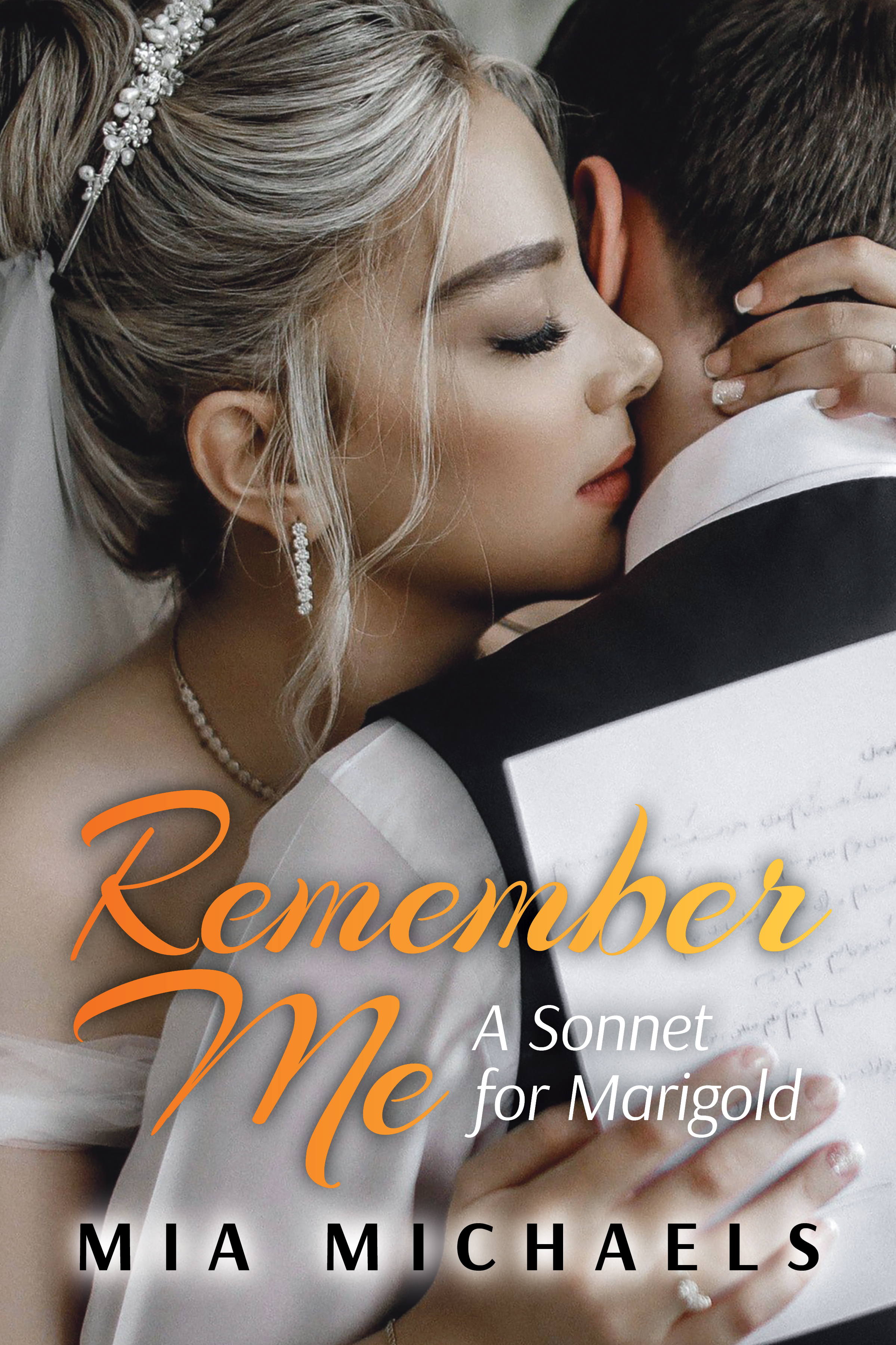
Here are excerpts from the back cover copy and blurb, along with the stunning cover. Who wouldn’t be drawn into this story?

Does true love really last forever? Author Mia Michaels creates a world where all reason is lost to the magic of love.

From the moment Mike’s plane crashes, Natalie’s world is turned upside down. As she struggles to remember the details of her life after suffering a brain injury in the same crash that killed Mike, a shocking revelation about an affair with the handsome pilot surfaces, leaving her questioning everything. 

Almost losing Natalie in the horrific incident gives Paul a wake-up call. He is determined to be the husband she needs, but at every turn, someone tries to sabotage their new commitment to one another. Who is sending her gifts, trying to turn her heart away from Paul? And what is the role of Mari and Pierre, two mysterious figures who seem to be connected to this love triangle?

 If only Natalie’s memory would return, perhaps she and Paul could rebuild their relationship before it’s too late.

Just when you think you’ve figured out the truth behind this love triangle, author Mia Michaels throws in an unexpected twist in this gripping Romantic Suspense novel. Remember Me will leave readers on the edge of their seats. Sprinkled with humor and a dash of fantasy, you’ll find everything you like—and more—in this modern breakout novel.

Don’t miss this unpredictable journey of true love. BUY NOW on Amazon.com

Most Important: Authenticity

I just finished reading a book of short stories—the first book by a new author. With no formal training in writing, this man broke most of the writing rules us more “seasoned” authors take so seriously.

It was almost 90% “telling”, which we all view as the biggest “no-no” on the planet. It contained “head hopping” (going back and forth from different points of view on the same scene), changes in tense, and so on.

The only rules he did not “break” were spelling, punctuation, and (mostly) grammar. No matter what the genre, breaking these make books intolerable to read. Readers deserve to read effortlessly without tripping over these blunders.

So, I asked myself, “why did I like this pleasant little book? I really don’t have an answer for you, except to say that this author wrote with “heart”, conviction, and confidence. He showed unique “voice.”

In my opinion, he has learned the most important “rule” of all—being authentic. Composing with a voice that is uniquely one’s own, growing organically from the writer’s sense of purpose and intellectual honesty.

 Are You Afraid of Getting Bad Reviews?

My dad always said, “Sometimes you have to take the good with the bad.” Nothing could be more true than in the case of book reviews.

Authors  know we need them, but we’re also fearful of occasionally getting less than the coveted 5 STARS.

What can we do about it? Or, better to ask, can we do anything about it?

First of all, we can write a book with a compelling story and make sure that it is free of punctuation and formatting errors. It probably goes without saying that the cover should be appealing and professional. Finally, the title should be attention-getting.

But, you ask, how should we respond to negative reviews if we get them?

First, don’t let negative criticism get to you. Read them with an open mind and see if there is something useful you can learn from them. BUT, don’t respond to them. It will only get you into an arguing match and the person and give others reading your comments online a bad perception of you.

Remind yourself that a negative review is just one person’s opinion and that not everyone enjoys the same thing.

Focus on the positive reviews—what readers enjoyed … what they say you did well.

And, by all means, don’t let it stop you from writing!

The Pesky Semi-colon

Talking with other authors, I realized that few of them knew the correct usage for the semi-colon.

I admit it has long been a struggle for me, too.

The internet is the “go-to” place for valuable information on thousands of topics, so that’s where I went to learn about it’s use.

Here’s what I found:  

  1. The semicolon is used to join two independent clauses instead of using a conjunction such as and. The group of words that comes before the semicolon should form a complete sentence, and the group of words that comes after the semicolon should form a complete sentence as well. The two sentences must share a close, logical connection. An example would be: Paul bought Brittany flowers for her dance recital; Sam gave her a pearl necklace.

2.  A semicolon should be followed by a capital letter only if the word is a proper noun or an acronym.

For instance, Billy bought a baseball with his allowance; Shawn purchased a skateboard.

3.  You can use semicolons to divide the items of a list if the items are long or contain internal

punctuation. The semicolon helps readers keep track of the divisions between items. For example:

Juan’s plan for his date with Felicia was to visit the county library; skate at the pond; and drink hot

cocoa at the neighborhood cafe. 

4.  When using a conjunctive adverb (such as finally, nonetheless, moreover, however, therefore,

otherwise, likewise, then, and consequently) to link two independent clauses, use a semicolon.

     An example is: I wanted to go for a walk with Robert; however, I also planned to go skating with

     Albert.

New Information on the Ellipsis

4601667285_100b998b59


In a much earlier post, we talked about the ellipsis and its function. However, I recently learned a couple of technical points I would like to pass along.

First, to review, an ellipsis ( … ) indicates that something has been omitted in the text, usually because the author doesn’t deem it necessary or in order to save space. (I often use one at the end of a sentence to show that the character’s thoughts are trailing off … ) Sometimes they can be used to show hesitation (I didn’t mean … oh, well, it doesn’t matter) or that the character has lost his train of thought.

Beware, however, that just like the exclamation point, the ellipsis can be overused. And that can annoy the reader.

Recently, I have found that there are rules to the exact placement of the dots.

When using an ellipsis in conjunction with other punctuation (commas, semi-colons, question or exclamation marks) treat the ellipses as if it is just another word in the sentence.

For example: “I didn’t know the iron was hot! … I was fortunate not to get burned.”

Here’s a case of other portions of text being eliminated: “I didn’t see the car coming straight at me. … I turned the wheel just in time.”

So, let’s look at the execution in the last example, above: The end of the sentence gets a period. Then, leave a space. Follow that space with the three dots. Finally, leave a space before starting the last sentence.

Remember, there are really only three dots. In the example above, what is shown may look like four, but in actuality, it is a period, followed by an ellipsis. 

Using an ellipsis is one case where spaces, and their placement, are very important.

Balancing Act

If you’re anything like me, you have a stack of books somewhere in your house that keeps getting taller. It seems like every book you read is replaced by one or two more!

The fact is, writers like to read. Need to read.

I’m not just talking about pleasure reading, which is a “given”. Every writer I have ever met has told me that it was the love of reading that sparked within them the desire to write.

No, I’m talking about reading about writing. The craft. Punctuation and grammar to be sure, but also reading about genres, point-of-view, voice, character development, plot and hundreds of more things we need to consider—need to master—in pursuit of excellence.

Once I started writing, I quickly realized the necessity of erecting two stacks of books. One I dubbed “Pleasure”; the other, simply “About Writing”. I have a rule concerning these books: Read from both stacks, simultaneously, so that I fulfill my need for learning AND for enjoyment.

So, what’s next on my stacks? James Scott Bell’s How to Write Dazzling Dialogue and Steven Pressfield’s Turning Pro are on top of the “About Writing” stack. And for pleasure, next up is Chapel Springs Revival by Ane Mulligan.

So, whether you keep an actual physical stack of books, like I do, or simply a list of “Must Reads”, my suggestion is that you try to balance your reading. After all, didn’t you hear this expression as a child? “All work, and no play, makes Jack a dull boy.”


Please visit http://www.spiritual snippets.com and http://www.5scribesandtheirstories.com to see what is going on there.