Drafting Can Be Rough

35652530632_c208dc2563

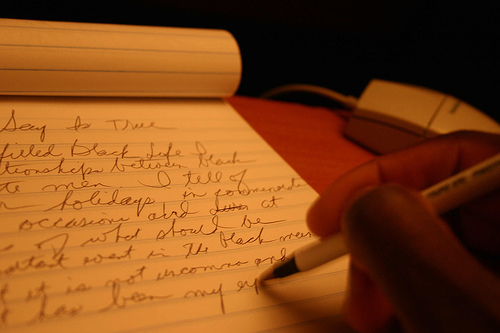
Drafting is the next step in the writing process. Whether you use a computer or a steno pad, whether you write with a pencil or pen, call it a “sloppy copy” or use another form of reference, you cannot escape this step in the writing process.

Using what you’ve accomplished so far in the prewriting process, drafting is the actual writing, chapter by chapter, of your book.

With a few tweaks here and there, all writers vary this stage of writing to end up with what works for them. Whether it is a program, such as Scrivener, or your own version of something else you’ve seen out there, now’s the time to get the old creative juices going. You can use a combination of approaches. After five books, I am still changing mine. 

What I am going to share, now, is how I approach the drafting stage of writing. If it is helpful as a whole, or only in part, use what makes sense according to your writing style, your organizational methods, and so on.

I use my computer at home almost 100% of the time. I found, early on, that using Mac’s “Pages” wasn’t the universally accepted format. You’ll need WORD. You can purchase WORD for Mac from the internet or Apple store, if you, too, own a MAC.

After closing my office door to insure quiet, I consult what I accomplished in my prewriting. I used to use giant Post-it’s of about 18” by 30” or so to keep my timeline,  characters and their descriptions straight. I have recently found it just as effective to use a spiral notebook and list these important details chapter by chapter. Clutter on my walls tended to make me nervous, whereas a simple notebook can be closed and stored in the closet for the next writing day.

Next I write … and write … and write …

I may finish and entire chapter or not, depending on the amount of time I have allotted. But, here is where I differ from most writers. After taking a short break for lunch or even overnight, I re-read my chapter, doing a quick edit of anything that stands out to me. These may be typos, mistakes in point-of-view, changes in scene order, or even sometimes deleting entire sections. These pre-edits serve two purposes: 1) Reading through the chapter gets my head back into the story so that I can continue my writing and 2) Just like the Post-its that previously cluttered my walls, it is a way of reducing what isn’t needed and getting down to story basics. 

(Most writers will tell you to keep writing all the way to the end of the book before going back to tackle any kind of editing. That would be ideal, if I could do it, but I just cannot…sorry, my mind just won’t get going unless everything else is cleared up, first).

Although I might do a little revising in the drafting stage, I find that it is wise to wait to do anything major until I have finished the entire book. Too many things can happen in the course of writing that might seem wise to revise early on; however, lots of difficulties will work themselves out in the course of writing. Save yourself a lot to time and work by sticking to your outline closely. Let your story “simmer” for awhile.

Before closing, I want to mention that I give my book, chapter by chapter, to my critique group. I rely on their comments heavily when editing. If there is something that these other writers do not understand (or like), then I am certain that my readers will not, either.

Next week- revising.

Love Me, Love Me Not


15674961512_0bb6066f94


I remember as a child, plucking petals from daisies and saying, “He loves me. He loves me not” until the stem was bare.

Today, I plucked petals from a sunflower. I repeated,  “Shopping. Writing. Shopping. Writing.” 

Do you sometimes need motivation to get down to work?

Even if writing is your passion, like it is mine, do you still find there are times we need to give ourselves a little nudge?

For instance, “If I write for two hours, I can watch my favorite television show, or if I write today, I will let myself go out for coffee with a friend this evening.” And so on.

Are we losing our interest in—or desire to—write? Are we abandoning our dream…our goal?

The holidays are busy with decorating, shopping and celebrating. It’s only natural that there is less time for writing, laundry, and cleaning. 

This season, I’m giving myself permission to spend time with family and friends. I may even go to a holiday movie.

 I’m not going to make myself feel guilty if I don’t get much writing accomplished. 

The computer will still be there when the holidays are over. And, who knows? When I reread what I last wrote, I may see it with a fresh set of eyes. My edits may come faster and easier.

I may end up with a better finished product.

I remember that when I was a teacher, I did my best teaching after Christmas break. I was refreshed and ready to tackle the second semester.

What will you do? Motivate yourself by plucking petals off a rose? Or call a friend and suggest you meet at the mall?

Two Sides of the Same Coin

33117169184_cdf592ed59

When you teach someone else how to do something, you learn a lot yourself.

Teaching has a way of cementing ideas, facts, procedures—all kinds of information—in our brains through the visual and auditory senses, as well as the writing (of the lesson plan, main points on charts or power point and so on).

So, I am going to suggest something you might think is crazy: I’d like you to consider mentoring a beginning writer. 

You may consider yourself a beginner and question just how much help you could be to someone else. But, even if you only stay a step ahead of them, the experience will be invaluable—as you learn TOGETHER.

I remember, as a first year teacher. being assigned to teach two periods of sewing in Home Economics. I had no experience. I didn’t know any of the terms, parts of the machine, not even how to read a pattern.

Each night, I would go home and teach myself what I needed to know in order to get through class the following day. This went on for the entire semester. I stayed, literally, one step ahead of my students. But, by the last day of class, I found myself actually looking forward to the next group of students. I felt increased competence and confidence 

So, the point is: whether you know a lot about the craft of writing, or you consider yourself a beginner, the experience you will gain by mentoring someone else will be invaluable.

It will be time well spent…because learning and teaching are two sides of the same coin.

Terrific Tuesdays

15985554795_22ccaf868e


Some years back, my sister and I used to meet up once a week for a day of shopping, with breakfast and lunch sandwiched in-between. Those “Terrific Tuesdays” were great.

We maintained the habit over the course of several years. However, our lives got busy with jobs, families, and masters’ programs, so we changed our ritual to once a month. It wasn’t long until it became two or three times a year and then, finally, we abandoned any hope of maintaining a regular schedule.

I know you can relate.

I should have hung onto those days like gold. We should have found a way…

So, just how does that relate to writing?

Well, let’s say that I have my writing calendar all filled out, appropriating 4-6 hours of writing  to each day of the week.

But, then the holidays come along and I’m torn between writing and meeting a friend for coffee and catching up on old times. Or, on a trip to visit Grandma for Christmas, I feel compelled to sneak up to the guest room and hammer out the plot for my next book while my kids remain downstairs helping to decorate the tree.

The truth is, there’s just no other way to create memories unless you’ve been there in the first place.

In the long run, whether our book comes out in March or May will not really matter. But, our interactions with others—our relationships—will grow, or they will die on the vine, depending on how much we cultivate them.

Take time to nurture yourself and others without guilt over meeting your writing goals.

I know there are very talented authors who will tell you to write everyday no matter what. I used to believe that. And, it led to a lot of heartache.

This year, I’m giving myself permission to take part in the celebration of the season, to laugh, to foster relationships, to turn off my computer and shut my office door.

No, this year I won’t be writing during the week of Christmas.

Instead, I will be making memories that will last a lifetime.

Christmas Letter


31082694023_c739f57abf


On my “To-Do” list this week, is writing my yearly Christmas letter to friends and family. I am making a list of trips, health updates, and accomplishments I’d like to include.

That got me to thinking about YOU and what I’d like to share as the Christmas season fast approaches.

First of all, I’d like you to know how much I appreciate your encouragement and support by reading/commenting on my blogs each week. I hope they have been both helpful and encouraging to you as we walk this “writing road” together.

To catch you up on what I am doing, currently, I can say that my Beta Readers are doing their work right now, critiquing Simon Says. I look forward to hearing from them over the next few weeks.

Meanwhile, I am busy writing back cover copy, revising my “About the Author” page, looking at a myriad possibilities for the front cover, and jotting down ideas for the second book in the series.

Finally, I am finishing up the manuscript for my second interactive Alzheimer’s book, I Remember Bible Stories,” as well as interviewing illustrators.

On a more personal level, I continue to be more involved in my parents’ lives at their care center and am taking on some of my mother’s previous roles, such as the big family gathering on Christmas Day. I am fortunate to live near a Honey Baked Ham store, as I am planning the meal around a nice spiral-cut ham.

I wish you all a Merry Christmas and the Happiest of New Years as you move ahead toward both your personal and writing goals.

Brenda

Fiction Writers, Do Your Research


32081067602_ffe40eb66c

I struck up a conversation with a gentleman in a hospital waiting room last week. I shared a little about my writing and he responded with a comment that made me think.

He made an observation that, to him, writing fiction was quicker and easier than writing non-fiction because it did not require research.

At first thought, I agreed with him. But, later that evening, I put pen to paper and contemplated whether or not that was actually as true as it appeared on the surface.

Here is a list of just some of the research necessary for every fiction writer to complete in order to write an authentic book:

a) Learn about the setting of your book, such as the state/country, the type of weather, the topography, terrain, type of government, and so on.

b)  What type of people live there? Is their speech distinctive?  In what type of industries might they be employed?

c)  In what year/time period does your story take place? What is going on in the world at that time? What hair and dress styles are prevalent? What music is popular?

d) Do any of your characters experience an illness or disability?  If so, you will need to know how it affects his life, treatments he might experience, etc. How will he interact with others?

e) Do your characters meet with a disaster? You may have to learn about floods, earthquakes, fires, and so on.

f) How old are your characters? What kind of music, games, activities are appropriate?

A good editor will catch some of these things, such as when mine caught it when I wrote  about something that would not have even been invented yet!!

But, don’t count on someone else to do it. You’ve got to do your homework and make your book as authentic as possible.

Some say a book is successful when it is so real that the reader actually feels he/she is experiencing the action right along with the characters.

Part of making this happen is doing the hard work ahead of time.

It’s called: research.

The Value of Persistence


68545759_b1b866f3c1

I recently read that Jerry Jenkin’s LEFT BEHIND was his 125th book. I can’t imagine writing that many books in the first place, but beyond that, it is astounding to me that he was able to keep at it until he hit

the big time,

pay dirt,

his big break.

Wow.

Then, I ask myself if I have what it takes to keep going in the face of

adversity,

competition,

sheer exhaustion.

Have you wondered the same thing?

Or, do you just get up every day and say good morning to God and your computer (in that order) and then fill your day with what you long to do more than anything else?

If so, you may be doing what I do. Taking it day by day. Moving ahead step by step until one day you realize that you’ve actually written a book!!!

Because you are

dedicated,

addicted,

and totally devoted.

Because you can’t imagine

not writing,

not creating,

not doing anything else with your life.


Protagonist vs. Antagonist

30091018165_2d04676559

In a writing workshop I recently attended, the presenter took us “back to the basics.”

If you’ve been writing for awhile, periodically it’s a good thing to revisit the essential elements of story.

The terms “protagonist” and “antagonist” are about as basic as it gets.

Let’s look at their definitions and what those two elements have to do with a well-written story.

The protagonist is the hero of the story—the central character whose journey we follow throughout the book. He’s the “good guy”. The one we cheer on. The one who experiences set-back after set-back, but emerges victorious at the end.

The antagonist, is the villain. His role is to block the hero’s progress toward his goal at every turn.

The cruel step-mother.

The demanding boss.

The rival for the hand of the princess.

Whoever they are, it’s essential that they do their part by providing those set-backs or road blocks to the hero on his journey.

It is this struggle to overcome that moves your story along to a satisfying ending.


Note: The inciting incident, another basic, was discussed in a previous post, entitled “Creatures of Habit.” You can read it under ARCHIVED POSTS.

I’ve Changed My Mind


2626749848_017cc65a8a


After a meeting, yesterday, the topic of how often one should write (every day? how many hours per day?) came up.

I listened as inexperienced writers eagerly listened to more seasoned authors on the topic that is as dear—and as often-debated—as toilet training is to young parents.

In one of my previous posts, I said that if you are researching for your book or article, or attending a conference, or viewing a webinar, that “counts” as your writing for the day.

Well, like I told the others after the meeting, I now know a bit more about the craft of writing and have changed my mind about what I advised a year ago.

There is no substitute for WRITING.

Here’s why:

You cannot learn to dance by reading a book or studying diagrams of nimble feet doing the Cha Cha.

You cannot learn to fish without baiting your hook and casting the line into the water.

There is no substitute for actually DOING.

We need to practice writing. All the reading and conference going—although worthwhile—cannot take the place of good, old-fashioned application.

Some people find themselves in such an endless cycle of “learning how to write” that they never actually sit down in front of the computer and try their hand at it.

They think that if they will just read one more book or watch one more webinar, then they will be ready…qualified…fully prepared.

All of that is well and good, but as my neighbor’s son studies his driving manual, I am reminded that he must also get behind the wheel and gain the experience of actually driving.

As a child, I heard my mother say, “Wishing doesn’t make it so,” many times. (Mostly this was in reference to having a clean room.) But, apply it to writing an article or book and you can make the connection, can’t you?

So, my conclusion is this: you must learn the skill of writing by writing, writing, and writing some more.

Every day?

Yes.

An hour a day?

At least.

Grab a partner and dance.

Bait your hook and cast your line.

Back out of the garage and get out on the highway.

Turn on the computer and let your fingers fly across the keyboard!

Platform Building, Part 2

27906087470_d1381c176b


Your writer’s platform is basically the group of activities you engage in that get your name and work noticed by the public. It’s marketing, not of a specific work, but of you as the author. It’s everything you do to build your brand.

Nowadays, publishers require that their authors are willing to get out there and market themselves. And, if you’re an indie author, as I am, all the more important for you to learn all you can about marketing.

  1. Aside from making publishers happy, there are a other side benefits to platform building:
  2. You may be able to generate some side-income from teaching and speaking.

You can also build your brand as an expert in your writing niche.

No matter what your goals, fans want to connect with a real person. That means we need to be ourselves, both as writers and individuals. We must show our true faces to the world.

The good news is that the technology of today (Twitter, Facebook, etc.) can play a major role in building our platforms, and are based on genuine, personal interactions.

*So, with an online presence on Facebook and Twitter being ESSENTIAL, I will also suggest that you start a website/blog and or weekly newsletter. Weebly and WordPress basic websites are FREE. I got mine (www.brendapoulos.org and www.spiritualsnippets.com and runawaysthelongjourneyhome.wordpress.com) started in practically no time at all. I am not techie, so if I can do it, you can, too! (There are others, such as communit.com, but these are the easiest to get started with and to keep going on a consistent basis.)

You’ll have to be diligent about blogging at least once weekly, adding your bio, announcing new book launches, sharing information on writing and about your life in as specific details as you are comfortable.

*Speaking at writer’s groups, libraries, book clubs, etc. can get you in front of the public. You’ll meet new people (potential followers) and meet other writers.

Although public speaking isn’t for everyone, it’s never a bad idea to get out there and let people see the face of the author behind the words. Take a guest book along with you, asking interested attendees to give you their email address so you can keep in touch with news, offers, etc.

*Teaching the craft of writing is another great avenue to help brand you as an expert. It will also give you something to blog about. Although this is often done as a freebie on an author’s part, you can make some decent side money by teaching either in person or online via podcasts or webinars.

So, decide what your specialty will be. Some websites I’ve seen involve cooking, crafting, scrapbooking, animals, travel—almost anything that is of interest to you will also be of interest to that certain group of others with similar likes, goals, and beliefs.

*Don’t overlook doing book give-a-ways on Goodreads and Amazon and Book Bub. You can also create products, such as pens, mugs, bookmarks, etc. Then, used these to market your brand by using them as give-a-ways at fairs, conventions, etc.

Get creative! I leave my business cards on bulletin boards and in restaurants when I pay my bill. A friend of mine leaves them in the pockets of the clothing she tries on when shopping!

*Support other authors. Join a professional writers groups/organizations. These are great ways to make contacts, lasting friendships, and get in on some great teaching. May I recommend American Christian Fiction Writers (ACFW) and the local chapter in your state.

It is important to remember that platform building will be different for every author because it will depend on your target readership, your unique expertise, and the message you want to present to the world.

Platform building is a creative process, just as is your own writing…

Use your imagination.

Begin small and build in increments.

Be persistent.

Don’t give up!

Neglecting your platform in today’s world can be a big mistake. You may have written a best-seller, but no one will know that if you don’t make your presence known!