Don’t Chuck It!

Writing last week, I felt the need to say the same thing I had in an earlier chapter, but in a different way so as not to sound repetitive. I decided to check my “Too Good To Toss” list.

If you don’t have one of these lists, you need to start one. Inevitably you will write something that you just love, but your editor or critique group will say it doesn’t work in your current writing.

Instead of being heartbroken that the world will not get it to read your carefully-crafted sentences, simply copy them into a file you can easily access for future use.

So, I resurrected a short paragraph I had written for a prior publication (but didn’t use) and slipped it into my current document where it worked perfectly.

So don’t trash phrases, sentences, or even paragraphs that you just hate to let go of; instead repurpose something from your Don’t Toss list!

(I also have lists of story ideas, book titles, etc. You never know when they may be useful.)

From A Reader’s Point of View

Today, I’m writing as a reader—not a writer.

And, as a reader, I want to read something new. I’m tired of the hundreds of books on the market that are nothing more than variations on a theme.

For instance, for the last few years there have been a plethora of books about a young, single girl who has just had a nasty break-up with her boyfriend. Her aunt dies and leaves her a bed and breakfast near the ocean. She finds a new love and new friends while renovating the bed and breakfast and building new clientele.

The next author comes along and changes the story ever so slightly. This time it is a newly-divorced woman whose grandmother passes away and leave her a bakery on an island. She’s never baked in her life, but follows her granny’s recipes and becomes world famous.

Enter writer #3. This woman has never been married. She, too, inherits an outdated inn in a charming hamlet. She brings it back to its former glory with the help of a handsome and newly-single handyman. And, well, you know how the story goes.

There are dozens of these variations on a theme out there from the Cat Who solves mysteries to the Dog Who sniffs out criminals, and so on.

In my humble opinion, these stories are spinning out of control.

Each one may have been well-written and enjoyable ONCE or TWICE, but over and over again?

Sometimes they fool me with their titles. I purchase them, beginning to read until around chapter three when the light dawns and I recognize the familiar storyline.

Disappointed, I revisit Amazon or Barnes and Noble. I still have hope that there are other stories out there worth telling—and reading.

Lest you think I am picking on these authors, I want to say in their defense that they are smart. They find a theme and run with it and they are making big bucks in a lot of cases.

And, there really are readers who enjoy reading every new cowboy romance, or granny detective story they can get their hands on.

Think back to when you were a kid and asked your parents to read Green Eggs and Ham over and over. 

Some stories we just never get tired of.

The Necessity of the “Black Moment”

This week, I’d like to discuss the importance of the “Black Moment” when writing fiction.

No, it’s not a time when an author fails to come up with new ideas, suddenly aware that the story is a flop and cannot come up with a way to fix it.

The Black Moment is the point at which obstacles stand in the way of the main character ever obtaining the desired goal.

Defeat seems inevitable.

This often takes place at the end of Act Two, but it has been effective as the crisis point slightly before or after that. The importance is that your book have one.

It has to be something that snags the reader’s heart and takes their breath away.

This is not just a simple change of heart or the discovery of a hangnail. 

It is betrayal, the uncovering of a lie, a cancer diagnosis, a revelation that you are not the real father of the darling baby girl with rosebud lips…

And from there, the story goes on a rollercoaster ride of struggles and disappointments until unbelievably the hero wins!

Readers cheer and find it nearly impossible to wait to read the next book in the series.

Exceeding Expectations

Authors will tell you that a book should have a satisfying end.

But just what is a “satisfying end”?

As a reader, I think of it as a conclusion that leaves me feeling that everything worked out as it “should.” The guy gets the girl, the man gets a promotion, the marriage is saved, the woman beats cancer, the cops catch the killer. 

The reader is satisfied.

But, what if we try to answer the question from the author’s point of view?

What if the outcome is not popular with his readers? Maybe it is not a socially acceptable ending, touts a particular political viewpoint that the majority of readers just cannot agree with, or the ending is a cliffhanger that doesn’t answer “Who done it?” or leaves readers scratching their heads and wondering “what happened?”

What if they just don’t “get it?”

Readers are left sad, angry, or frustrated that they just spent five hours reading something that didn’t end the way they had hoped.

Readers pay “good money” for our books and deserve to get whatever the author promised on the back cover and/or in their marketing. Writers create certain expectations in their readers’ minds and—as much as possible—we need to meet them.

A good author delivers. 

And, a great author exceeds expectations.

The Pesky Semi-colon

Talking with other authors, I realized that few of them knew the correct usage for the semi-colon.

I admit it has long been a struggle for me, too.

The internet is the “go-to” place for valuable information on thousands of topics, so that’s where I went to learn about it’s use.

Here’s what I found:  

  1. The semicolon is used to join two independent clauses instead of using a conjunction such as and. The group of words that comes before the semicolon should form a complete sentence, and the group of words that comes after the semicolon should form a complete sentence as well. The two sentences must share a close, logical connection. An example would be: Paul bought Brittany flowers for her dance recital; Sam gave her a pearl necklace.

2.  A semicolon should be followed by a capital letter only if the word is a proper noun or an acronym.

For instance, Billy bought a baseball with his allowance; Shawn purchased a skateboard.

3.  You can use semicolons to divide the items of a list if the items are long or contain internal

punctuation. The semicolon helps readers keep track of the divisions between items. For example:

Juan’s plan for his date with Felicia was to visit the county library; skate at the pond; and drink hot

cocoa at the neighborhood cafe. 

4.  When using a conjunctive adverb (such as finally, nonetheless, moreover, however, therefore,

otherwise, likewise, then, and consequently) to link two independent clauses, use a semicolon.

     An example is: I wanted to go for a walk with Robert; however, I also planned to go skating with

     Albert.

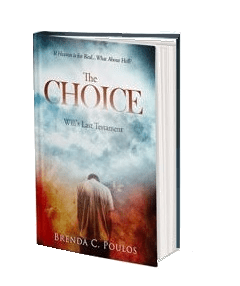
Free E-book on June 1

The loss of a baby.

A terrifying cancer diagnosis.

June 1, The Choice is Free!

That’s right, I hope you’ll zip over to Amazon for a  free e-copy of my best-selling book, The Choice.

This is my birthday gift to YOU!

I am having a little trouble with the following link, so if you do, too, please just go to Amazon/books and type  The Choice: Will’s Last Testament in the search bar.

www.amazon.com/Books-Brenda-Poulos               

And, while you’re online, check out my NEW website at: www.brendapoulosauthor.com 

You CAN Learn From Others’ Mistakes

I’m an avid reader—and writer.

And I’ve come to this conclusion: we writers need to read examples of good writing. We can learn so much from reading the works of renowned authors.

Sentence structure, plotting, character development, just to name a few.

But we also need to read the works of beginning authors and perhaps those not so “accomplished” writers. We will see mistakes that weaken their stories, make plots confusing, make characters flat and unappealing, and so on.

By contrasting the two writing examples, we can identify strengths and weaknesses in our own writing. We can learn from writers at both extremes.

And strive for perfection!!

Passive Voice vs. Active Voice

I uploaded a page of my chapter into an editing program I had considered purchasing. In less than thirty seconds, the screen blinked and then displayed this message: Be careful not to rely on passive verbs in your writing.

Yikes!

Had I really written something so “non-exciting” that they actually called it passive?

Yes; I vaguely remembered that term. I decided to refresh my memory. Here’s what I found.

Let’s start with the basics: a verb is an action word.

Example: Run, cry, hit, sing.

Depending on how you word a sentence, a verb can be passive or active.

Example of active verb:  

Jon beat Peter in a game of chess.

Example of passive verb:

Jon was beaten by Peter.

In the first example, the subject of the sentence (Jon) is doing the action. In the second, something is done to the subject.

The term voice refers to these two different ways of using verbs.

Passive voice is used most often in formal documents, research papers, and so on.

Active voice is used most often in creative writing (fiction).

Passive verbs are broken down into: present simple, present continuous, present perfect, past simple, past continuous, past perfect, future, and future perfect. There are good examples of all of these on the internet, so I won’t go into each here. 

Especially since my purpose here is to remind those of us writing fiction, that we need to make our writing exciting by using action verbs (active voice).

No; I didn’t purchase the editing program. But its blinking screen and its warning in red CAPITAL LETTERS will be forever etched in this writer’s brain.

Ready to Make a Few Changes?

A few months ago, I told a new acquaintance about my struggles in marketing. (We had been talking about her daughter who is graduating from high school this year and her need for a part-time income. I told her mother that it was amazing to me that “young people” find technology so easy to use.)

So I saw this meeting as an opportunity to make some changes.

I’m hiring this eighteen-year-old to put a fresh face on my Facebook pages and my Amazon advertising—and earmark some of my marketing dollars toward a new “look” for my online presence.

Will my marketing dollars be well spent?

I hope so. 

Because the story about the guy who never saw any changes in outcome because he kept trying the same strategies time after time is really my story.

Is it yours, too?

Maybe it’s time for you to change where you write—or when. Perhaps you need to read a few books on the craft of writing or attend a conference.

Whatever you need to change, there’s no time like the present to make that commitment—to yourself and your readers!

Can You Say It In Three Minutes?

Are you able to pare your story down to three to five sentences?

Can you say it smoothly within three minutes?

The sole purpose of a pitch (the in-person conversation with an editor or publisher) is to convince them to give your story a look.

Be sure your pitch includes:

Hook: Why they should read your book. 

Synopsis: What the story is about. (Be sure to include the title, length, and genre of your novel). Your

target audience; and where it fits in the market (Titles of books similar to yours—and why yours will be different); and your bio.(including why you are qualified to write the story and what you are willing to do to promote your book after it is published.)

Remember to take your business card with you. You don’t want to be writing down your information on a gum wrapper while going out the door!